
Angelina Godinez ’28
Managing Editor of Social Media
Over the course of two weeks,Visiting Assistant Professor in Critical Race and Political Economy Pilar Egüez Guevara delivered two workshops debuting part one of her film “Guardianes de Cacao” —translated to English as “Keepers of Cacao” — at both Amherst College and the University of Massachusetts Amherst. These workshops were held completely in Spanish, and were just two of five given within Massachusetts and New York. This is Guevara’s second time offering this cacao workshop in her Healing through Language and Culture course, in addition to offering options outside of Mount Holyoke College. Similarly, it was the first time she debuted her film, “Guardianes Del Cacao.”
The workshop began with a journal prompt asking the attendees to reflect on what brought them to the workshop, what expectations or emotions they had and what they hoped to gain. After discussing various skills taught in her class, Healing through Language and Culture, Guevara went on give some background information to her four part docu-series, “following the guardians of fine aroma cacao in Ecuador and Mexico: Afro-Ecuadorian and indigenous elders, agroecological farmers, traditional cooks, artists, and scholars who protect ancestral cacao varieties.”
Not only does this film make an effort to cover the four natural elements of keeping cacao — water, soil, air and fire — but it confronts threatening oppositions to the practice, such as the ability to preserve cultural practices, mining, natural geographic shifts, biodiversity, monocrop expansion and market pressures on endangered rivers. This allowed attendees of this workshop to gain multiple perspectives on the work put into the traditional harvesting of cacao.
Here, attendees learned about the Chocó Andino, an endangered and biodiverse region that spans from Northwest Ecuador through, Columbia and Panama, housing 12 types of forest, 270 mammal species, 210 reptiles and 2110 different plants, including a variety of cacao trees that provide cacao to both small and large agricultural companies.
The Rainforest Partnership, a global non-profit that works with indigenous communities in rainforest conservation, is currently working to attempt to preserve as much of the unique ecosystems, biodiversity and water sources the Chocó Andino has provided for years. This is done by establishing private reserves that “ensure lasting protection of standing forests,” and “allow for natural regeneration of degraded areas,” enabling the traditional harvesting of cacao in the Mashpi conservation area. The importance of preserving this land, specifically the Mashipi region, is further emphasized in the film by Cacao expert, Flor María Castillo Quiñones.
Guevara then went on to demonstrate how Mashpi cacao is special due to the traditional indigenous practices of harvesting cacao, as opposed to machine-made harvesting. Throughout this workshop the importance of traditional practices and cultural preservation were emphasized, sharing the ties it has to one's daily life and how one connects with their culture and ancestry.
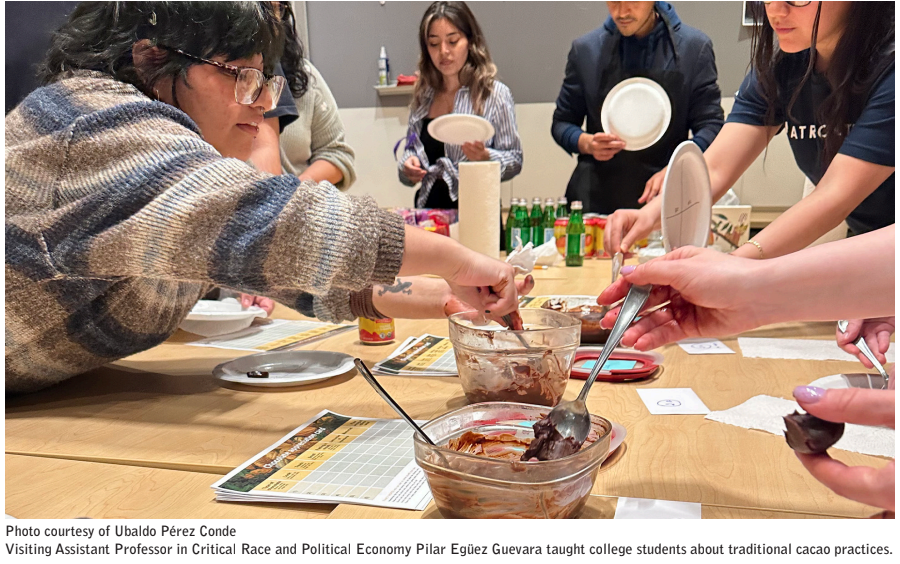
Following the presentation, attendees were able to hand-make cacao truffles and experience the importance of physical contact with cultural recipes, shining an overarching light not only on Guevara's work to document these preservation practices, but further illustrate the history behind each bite.
Madeleine Diesl ’28 contributed fact-checking.