
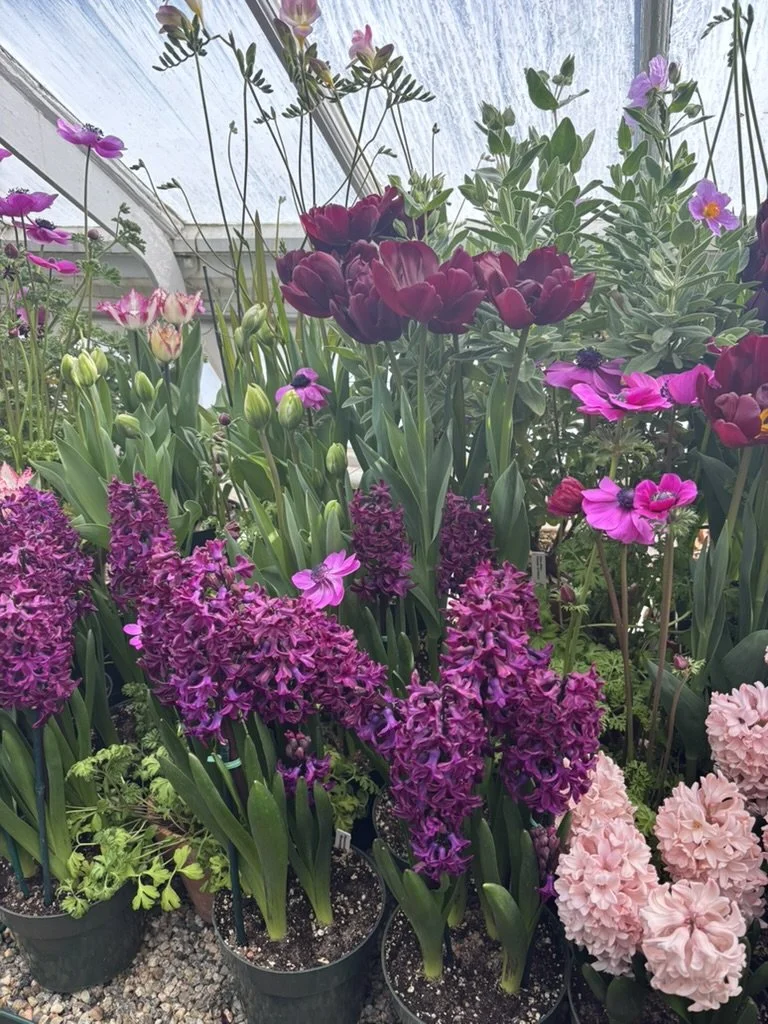
Photo by Madeleine Diesel ’28
BY MADELEINE DIESL ’28
COPY CHIEF
After an especially long, cold and wet winter, spring has officially sprung at Mount Holyoke College. The snow has melted, the birds are singing and the Mount Holyoke Botanic Garden is holding its 54th annual Spring Flower Show in the Talcott Greenhouse. This year, the show ran from March 7 to 22, open 10 a.m.-4 p.m. daily.
Three types of flowers in particular stole the show: Tulips, daffodils and hyacinths.
Tulips, a perennial staple, are plants of the genus Tulipa, which encompasses more than seventy-five different species. Even within these species, tulips boast a large diversity of color and form. There were dozens of varieties of tulips at the Flower Show, from velvety purple blooms to spiky orange flowers with petals that looked like fire.
Daffodils, with their cheery yellow hue, are well known in Massachusetts for being some of the first flowers to bloom in the early spring. The common name for the Narcissus genus, daffodils contain even more species than tulips do. Morphologically, daffodils are unique because of their large corona — the crown-shaped, trumpetlike center of the flower — and hooked stem. Alongside the typical yellow flowers, the Botanic Garden displayed bright white daffodils with contrasting orange coronae.
Hyacinths are known for their clustered flowers and strong fragrance; if you noticed a floral scent while walking past the greenhouse, that was likely the hyacinths at work. Unlike the previously mentioned flowers, there are only a few species in the Hyacinthus genus, yet there are still a large variety of colors. Most of the hyacinths at the Botanic Garden were a deep purple hue, but there were also pink, white and blue ones.
The science behind flowers is just as fascinating as their appearance. Flowers serve as the reproductive organs of angiosperms, or flowering plants. In the wild, their large diversity of size, shape and color is partially a result of their coevolution with specific pollinators. For example, a flat, yellow flower might attract a bumblebee, while a long, red flower would be more suited to pollination by a hummingbird. The giant blooms that can be found at the Flower Show and in most American gardens are mostly due to selective breeding by farmers to create the best smelling, biggest, most appealing flowers possible; there is no selective pressure to appeal to a certain pollinator when a human is willing to do all of the work.
In addition to the hundreds of blooms on display, the Botanic Garden was also selling potted bulbs of the Narcissus, Muscari and Scilla genera for $5 each. Though the show is over now, members of the Mount Holyoke community can still stop by the greenhouse any day from 10 a.m. to 4 p.m. to see their vast collection of plants.
Maeve McCorry ’28 contributed fact checking.
