
By Kennedy Olivia Bagley-Fortner ’26
Staff Writer
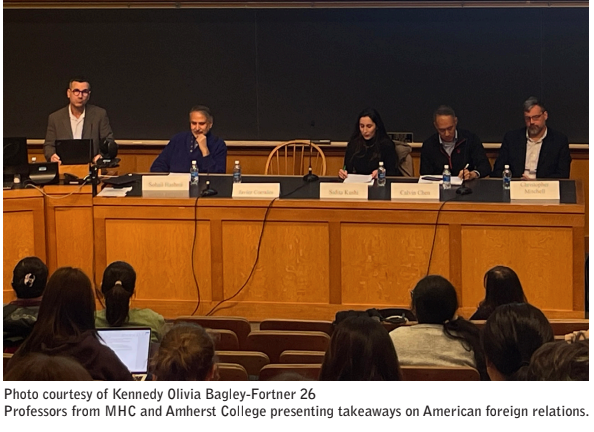
On Feb. 12, the McCulloch Center for Global Initiatives brought together four professors from Mount Holyoke College and one professor from Amherst College to discuss and analyze the Trump administration’s foreign policy. The panel was called “US Foreign Policy: The ‘Donroe Doctrine’: Where Is It Leading Us?”
“There have been few figures as polarizing as Trump,” stated the moderator, Professor Sohail Hashmi, who specializes in politics and ethics at Mount Holyoke College.
During this past year, we have seen global divisions that have been created by domestic and foreign policy.
As Professor Hashmi closed his opening remarks, he asked the audience to consider some fundamental questions that shaped the panel discussion and the future of American policy: Are we witnessing the inevitable policy shift that comes with each new administration in Washington D.C.? Are we witnessing something much more elemental and dramatic? Or are we watching the unraveling of the rule-based post-World War II international order?
While politics is a deeply complex and nuanced subject, Hashmi presented a statement on the issue that can resonate with many people. By looking at the Trump administration’s foreign policy, our goal is “to think together beyond the next Truth Social post.”
The panel was divided into four sections, tackling a wide array of subjects. Mount Holyoke College Professor of Politics, Sidita Kushi, focused on Trump’s second first term and his newfound enthusiasm for military intervention.
Amherst Professor of Politics Javier Corrales gave his expertise on the United States’ intervention in Venezuela and Latin America. Mount Holyoke Professor of Politics Christopher Mitchell talked about Trump’s tariff policies and U.S.-EU relations.
Lastly, Mount Holyoke College Professor of Politics Calvin Chen gave crucial insight on the current state and the future of the U.S.-China relations, and relations within the Indo-Pacific.
Professor Kushi argued that the United States has prioritized its military force at the cost of its diplomatic relations. Even though Trump has stated numerous times that his main focus has been on domestic issues, his current foreign policy begs to differ.
In her explanation, Kushi cited the Foreign Affairs article “Imperial President at Home, Emperor Abroad” to give the audience a better understanding of Trump’s policies. Foreign Affairs explained that Trump’s “unrestrained executive power” has been creating tension domestically as well as internationally.
Trump has the power to “do whatever he wants when it comes to anything related to foreign policy or national security,” according to Foreign Affairs. He has shipped noncitizens to prison camps in El Salvador, attempted to impose widespread tariffs on countries around the world, gut foreign aid, bully allies and deploy the military on American citizens.
Kushi added on to her argument by stating that the current administration has scaled up its militaristic operations, and seeks to “supercharge the U.S. militarization base.” In December 2025, the house passed a “$900 billion defense policy bill that would give U.S. troops a raise and codify much of President Trump’s national security agenda,” The New York Times reported.
In early January 2026, Trump “proposed setting U.S military spending at $1.5 trillion in 2027,” according to AP News. Here, we can see that the United States military budget will likely continue to grow.
According to Kushi, the Trump administration is prioritizing military and direct force over diplomacy. This administration has moved away from traditional diplomacy and resorted to another option: military operations.
Professor Corrales added onto Kushi’s point by analyzing the startling case of Venezuela.
Corrales emphasized that throughout the history of U.S. interventionism, there has been an effort to get rid of the global “troublemakers,” However, in the case of Venezuela, Trump might have removed the big troublemaker — Venezuelan President Nicolás Maduro — but left the rest at play.
According to Corrales, the Trump administration has said, “Let’s take the bad guys and start to become friends with them,” especially in the oil business.
While getting rid of Maduro can be viewed positively, leaving his administration as it is can be seen as a huge mistake, which the current administration doesn’t seem concerned about. As Corrales put it, this administration feels no embarrassment at getting rid of other political powers. On the flip side, there is a complete acceptance to work with the Maduro administration.
While the case of Venezuela is very unusual, Professor Corrales still has hope that with Maduro gone, new forces can emerge that can create a model of fair rules and democracy.
Professor Mitchell brought up Trump’s tariff policies and gave a brief overview of what tariffs are and how they operate. When the government raises tariffs, import and domestic prices rise, and as Mitchell puts it, it’s a tax on consumers.
While implementing tariffs can be beneficial, Mitchell points out that they can do more harm than good. He summarized that Trump’s policies have three complications: Firstly, these tariffs have caused legal uncertainty. They prompt people to ask the question: Is Trump allowed to do this? The current answer is no. After a long-awaited tariff announcement, on Feb. 20, the Supreme Court ruled that his “reciprocal” tariffs were unconstitutional, according to AP News.
The second complication that Mitchell raised is the topic of political uncertainty. Mitchell used the phrase TACO, meaning “Trump Always Chickens Out.” In the case of Trump’s tariffs, “he has threatened far more than he has carried through on,” NBC reported. A specific example that we’ve seen in the TACO effect was with his E.U. tariffs.
He threatened Europe with a “20% tariff as part of his ‘reciprocal’ tariffs which were announced April 2. But hours after those tariffs were scheduled to go into effect, Trump reduced tariffs on Europe and most other countries to 10% for 90 days to give his administration time to work out individual trade deals,” added NBC News.
Mitchell ended his explanation by listing the third complication: Tariffs affect everything. Countries don’t create and produce standalone items all on their own. Everything is a collaboration, and countries rely on the importation of materials from around the globe. When tariffs are raised, this limits global trade and stunts affected countries’ economies.
Professor Chen started his discussion by asking a question: Does the “Donrone Doctrine” represent a major “rupture” in the U.S.-China relations?
The “Donroe Doctrine” is “a Trumpian twist on a 19th-century idea” of the original Monroe Doctrine, The New York Times reported.“In 1823, President James Monroe aspired to stop European powers from meddling in the [western] hemisphere.”
However, Trump has taken a completely opposite approach to the original doctrine, where he has been focused on asserting American dominance in the western hemisphere. Secretary of Defense Pete Hegseth wrote that “the Western Hemisphere is America’s neighborhood – and we will protect it,” added the New York Times.
In Chen’s analysis, he stated that this “Donrone Doctrine” does not represent a major rupture in U.S.-China relations, but an acceleration and intensification of a clear pattern of bipartisan American hostility.
China has been accustomed to policies of this kind. Prior to COVID-19, Trump imposed 20% tariffs on Chinese goods, and President Biden kept those same tariffs in place.
Using his comparative studies background, Chen prompted the audience to talk about this issue not only on an international scale but also domestically. Chen stated that we should think about the recent developments in “intermestic” terms to understand the future of U.S.-China relations.
One development has been in Venezuela. As Chen puts it, the capture of Nicolás Maduro was a “surprising blow to Chinese ambitions, but not fatal.” While China is the largest purchaser of Venezuelan oil, that oil only makes up about 4 to 4.5% of China’s seaborn imports. This means that if Venezuelan exports were disrupted, it would only affect the CCP for a short time. China can make up its oil consumption from other countries such as Canada, Iran and Iraq.
However, Chen does point out that this conflict could potentially affect China’s prestige.
For the past two decades, “Beijing has sought to build influence in Latin America,” not only for economic opportunities but “to gain a strategic foothold on the doorstep of its top geopolitical rival,” Reuters reported.
President Trump’s “move against Maduro was intended in part to counter China’s ambitions,” Reuters reported. “Beijing can protest diplomatically, but it cannot protect partners or assets once Washington decides to apply direct pressure,” Craig Singleton of the Foundation for Defense of Democracies added.
While the world of politics can be difficult to grasp, it is panels like this that bring issues to the forefront.
As we progress further under the rule of the Trump administration, it is important that we ourselves stay informed to fight back against this “imperial president.”
Quill Nishi-Leonard ’27 contributed fact-checking.