
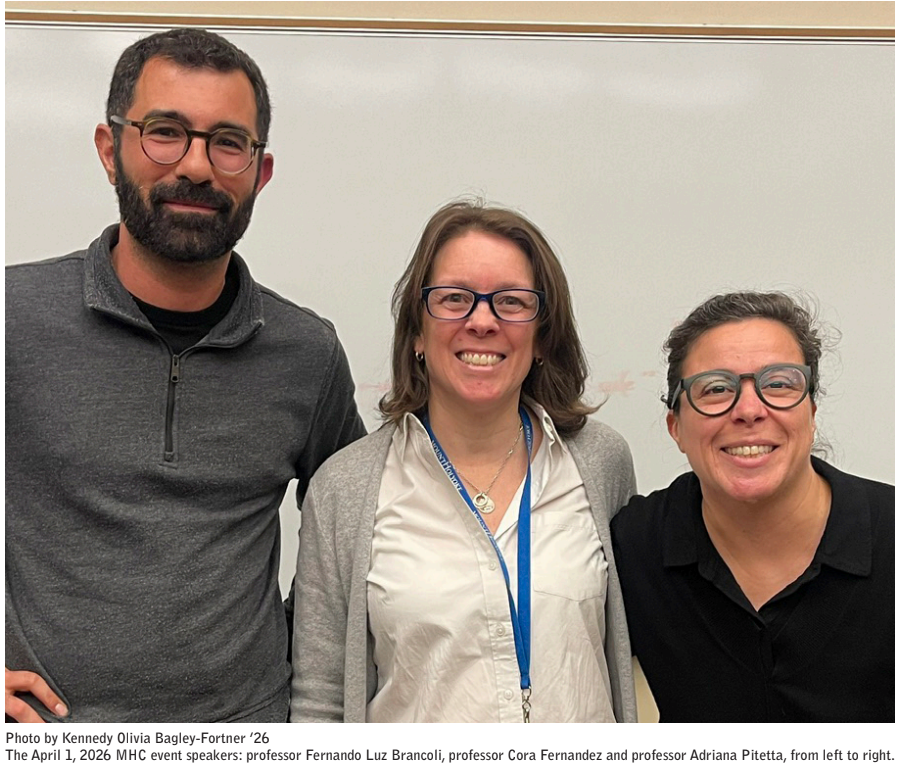
By Kennedy Olivia Bagley-Fortner ’26
Staff Writer
On April 1, the McCulloch Center for Global Initiatives, the College’s politics department and the Spanish and Latin American studies department hosted an insightful discussion titled “The Far Right in Latin America: A Conversation with Fernando Luz Brancoli.”
Brancoli is an associate professor of international security and strategic studies at the Federal University of Rio de Janeiro. The panel’s conversation also included two Mount Holyoke professors: Assistant Professor of Spanish Adriana Pitetta, and Associate Professor of Politics Cora Fernandez Anderson, who also serves as chair of the politics department.
The rise of right-wing movements and politics in America gives us crucial insight into our current political climate, and the same can be said for Latin America. Brancoli kicked off the conversation by giving an overview of the far right in Latin America.
The far right in Brazil is still very connected to its authoritarian past; in fact, as Brancoli puts it, the far right is “deeply embedded” as a part of the “authoritarian movement that was never completely erased.” Brancoli made the point that many Brazilian leaders were never charged for their past brutal actions.
Brazil’s rise to democracy was a tumultuous one. After the end of World War II, Brazil emerged as a Populist Republic, from 1946-64. During this period, Brazil transformed into a “more democratic political regime,” according to the Library of Congress. Brazil held official presidential elections, and focused on various economic, developmental and social changes. However, the country’s democratic system did not last for long.
The Populist Republic continuously struggled “over control of Brazil’s national political scene, [which] prompted interventions from Brazil’s military,” the Library of Congress states. Brazilian presidents became accustomed to threatening military action. During this time, the Brazilian government went through numerous ups and downs, including political polarization and military instability.
Fearful that the Brazilian government was shifting towards communism, the United States supported the military coup of 1964. This coup resulted in Brazil’s 21-year military dictatorship.
Under this dictatorship, about “4,841 elected representatives [were] removed from office, [about] 20,000 people were tortured, and 434 people [were] killed or disappeared” Human Rights Watch reported. In addition to this, the Human Rights Watch stated, “Nobody has ever been held accountable for those abuses.”
This circles back to Brancoli’s point on how the Brazilian government and many other Latin American administrations have not yet confronted their brutal pasts. If governments are not willing to confront their pasts, they are more likely to repeat the crimes of the past, Brancoli stated.
For Brazil’s far right, “You have to make points about the past, you can’t just forget them,” Brancoli said. Here, Brancoli’s message is clear: if governments and politicians do not acknowledge and confront the past, history will repeat itself.
In addition to the reluctance of Brazilian leaders not wanting to confront its past, Brancoli also commented on the country’s progressive movements, and stated that many of these groups do not know how to deal with the far right. This has caused internal fragmentation for the left.
This kind of fragmentation and instability can lead to bolstered support for the far right. This has caused many left-wing politicians to suggest that they should use similar tactics to those of the right. Brancoli pointed out that some Brazilian politicians feel they have centered their political agendas on supporting progressive movements, which in turn has allowed the right to directly counter them on numerous issues.
“Brazil has some of the world’s strongest legal protections for queer and trans people,” the U.S Committee for Refugees and Immigrants reported. In addition to the legalization of same-sex couples in 2013, “Trans citizens can change their identity card to reflect their lived gender identity, and do not have to vote under their dead name.”
This has caused the far right to counter arguments about the destruction of the nuclear family, which has instilled anxiety into the older Brazilian population about the government supporting LGBTQ+ rights. This emphasis on going back in time, or for Brazilian left politicians to start adopting a right-wing political agenda, is frightening to Brancoli. He stated that the country wants to “go back to the basics, which is scary.”
Towards the end of the discussion, Brancoli discussed the similarities between the United States Capitol attack on Jan. 6, 2021 and the Brazilian Congress attack on Jan. 8, 2023.
In an interview with the University of Illinois Urbana-Campaign, Brazilian History Professor Jerry Dávila said the goal of this attack “was to create a siege situation that would provoke a military intervention that [instigators] believed would bring ousted president Jair Bolsonaro back to power.” Similarly, the Jan. 6 attackers “believed that they could halt the congressional certification of President Biden’s election,” Dávila added.
According to PBS, Bolsonaro was sentenced to a 27-year prison sentence for this coup, while Trump never faced any real consequences. While this was a huge step for Brazil’s democracy, Brancoli added how, after Bolsonaro was jailed, many felt that the far right had been sufficiently combated, which made the left vulnerable.
His imprisonment gave the left a sense of security, making them forget that there was much more work to do to protect democratic values. This provides the opportunity for the far right to seize control again.
To end the conversation, Brancoli told the audience that a “great way to [understand] Latin America is through the security lens.” It all boils down to wanting to feel safe, and if one side sees a threat to their security, then the other side will also retaliate.
Sophie Frank ’26 contributed fact-checking.