
By Ani Mecca ’27
Staff Writer
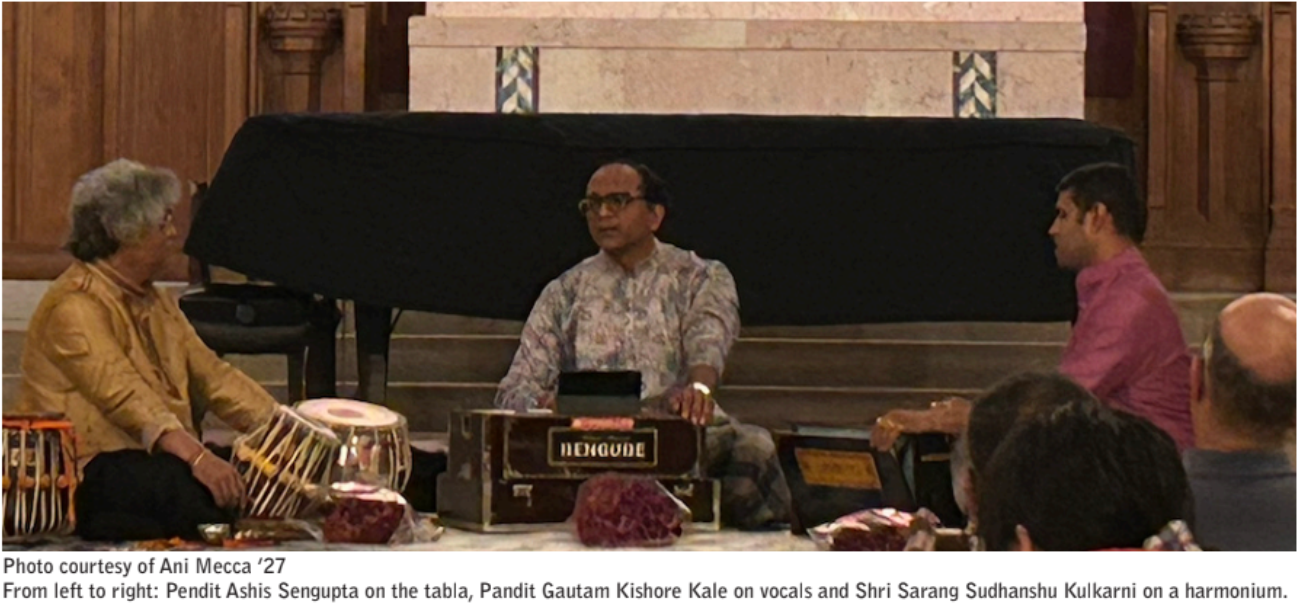
On April 18, Mount Holyoke College enjoyed semiclassical Indian music performed by renowned Northern Indian performers, in an event titled “Popular Music of India.” The musicians included Pandit Gautam Kishore Kale on vocals, Pandit Ashis Sengupta on tabla or handrums, and Shri Sarang Sudhanshu Kulkarni on the harmonium.
The concert was held in Abbey Memorial Chapel and attracted a mix of Mount Holyoke students, South Hadley locals and enthusiasts of Indian music. Abbey Memorial Chapel’s wide, open space and lofty ceilings provided ideal acoustics for the emotional and heartfelt performances of Kale, Sengupta and Kulkari.
The first three performances of the night were described by Gautam Kale as emotional compositions. They included devotional pieces to the Hindu deities Ganesha and Vishnu, and renditions of famous Indian poems from the modern era.
The next compositions were Ghazals, a genre of music in which Urdu poetry is sung against intricate musical melodies, according to Serenade Magazine.
According to the classical music platform Serenade, the Ghazal tradition originated in Persia, eventually making its way to the Indian subcontinent during the medieval period.
In the contemporary period, Ghazal compositions continue to draw appeal, whether they are featured in Bollywood films, intertwined with other genres including rock, electronica and jazz or performed in live settings such as here at Mount Holyoke.
This performance was the third installment in a series of free concerts comprising “A Festival of Indian Music” across the Five Colleges. On Wednesday, April 15, Gautam Kale, Ashis Sengupta and Sarang Kulkari explored the intersectionality between music and devotional traditions in India at Amherst College. The following day, at Smith College, the three performed a concert celebrating classical Hindustani music.
The concert was sponsored by the Department of Art History and Architectural Studies, the McCulloch Center for Global Initiatives, and the Amy M. Sacker Memorial Lecture Fund.
Quill Nishi-Leonard ’27 contributed fact-checking.