
By Anna Goodman ’28,
Staff Writer
Content Warnings: this article discusses racism, xenophobia, police brutality, mass murder, and, briefly, school shootings, gun violence, and deportation.
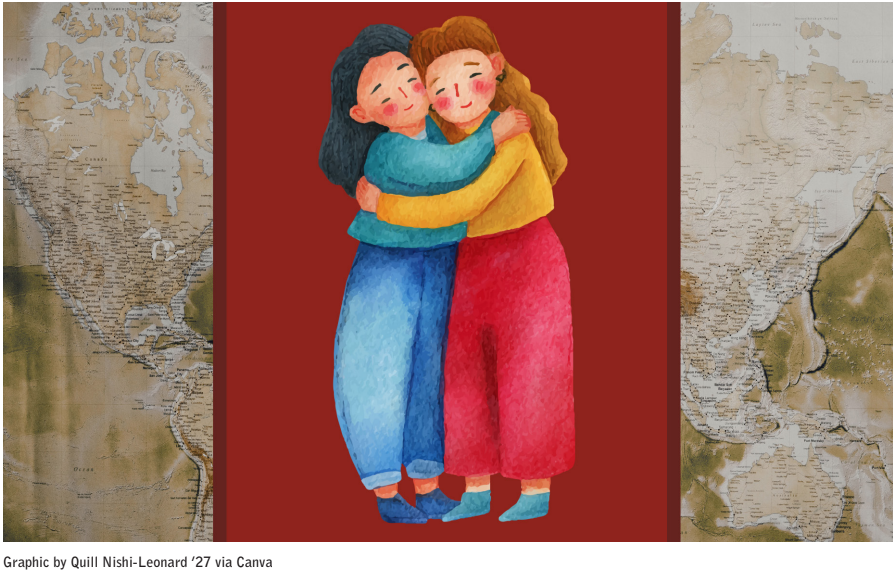
I’m hugging my friend on the top floor of a history museum in a country that belongs to neither of us, when I am hit by the realization that I have been wrong all my life.
I’m American and she’s from China, so we’ve been here the better part of the afternoon, slowly combing our way through with the help of translators and a lot of tilting our heads at 45 degrees, as if the Korean language will make more sense that way.
We stop at an exhibit on student protest.
“They spelled it wrong,” my friend says, looking confused. “It’s Tiananmen, not Tiannamen.” And that’s when it dawns on me that she doesn’t know.
I sit her down. I find Brittanica. I hit the translator button, because I doubt they teach you the words for “massacre” and “government crackdown” in mandatory English class. I hand her the phone. I watch all the color drain from her face.
“I love my country,” she tells me finally. “I want to believe that we’re better than this.”
I first learned about Tiananmen Square in my 7th grade global history class. A series of organized workers and student protests, over a million people strong, in May and June of 1989 centered around Tiananmen Square in Beijing, with various smaller ones in other major cities.
Protests that ended with a martial law declaration and an infamously brutal government crackdown on June 4th that left, according to Chinese authorities, 200 dead and 3,000 wounded. The actual number of dead remains unknown, though estimates range from 1,000 to 10,000, with the number of those wounded and imprisoned likely much higher.
In the years since, this brutality has only become more infamous overseas, with China banning dozens of words that could have even a passing reference to Tiananmen: “Massacre.” “Square.” “Tank.” “Protest.” And the web closes tighter. “June 4th.” “That day.” “ 63 +1,” which adds up to “64” or June 4th, or any combination of 6 and 4 that comes just a bit too close for comfort. When attempting to assert control over your citizens, you can never be too careful.
But I’m not thinking about any of that when I first meet my friend on a sweltering summer day in Korea. I’m thinking that we are two foreigners, foreign both to each other and the country we’re standing in, and I’m thinking that she has a cool haircut and a cute phone case. I walk up to her with my aggressively mediocre Mandarin and say: 你好, 我是安娜. “Hi. I’m Anna.”
“Hi,” she says back in near-perfect English. “Nice to meet you.”
We bond over a mutual love of K-pop and a mutual disdain of the humidity at the peak of summer. We get brain freeze ordering bingsu — Korean shaved ice cream — and teach each other random idioms. (“Why would something being easy mean it’s a piece of cake?” “Honestly, I don’t know.”)
When we go our separate ways on separate planes, we cross our pinkies that we’ll stay in touch.
“Come visit!” she tells me. “I want to teach you how to make tanghulu and take you to the best hotpot and see the Great Wall.”
“Come visit,” I tell her. “I want to take you apple picking and introduce you to all the dogs I’ve babysat and show you how many kinds of people there are in New York City.”
“Promise?”
“Promise.”
Perhaps it’s easy, simpler, to see us as two opposite people on opposite sides of the world. Perhaps in some ways we are.
I could tell you about the stereotypes. My friend had fourteen hour school days, six days a week, in uniform, from the time she was eight years old. She thought all Americans would hate her. She knew Tiananmen Square as only a place.
I grew up doing active shooter drills starting in elementary school. I was expected to pledge allegiance to my country, right hand over my heart, every morning. It was my parents who taught me about students protesting the Vietnam War, not my teachers.
As horrified as we were by each other’s experiences, our own were just normal. Saying “That’s the way it is,” was the common thread. Perhaps it’s a marker of childish ignorance that I was shocked my friend was so self-aware. That not every single person out of a population of over a billion blindly believes everything that their government tells them. That somehow, I had just never imagined that a Chinese person could both know the truth about Tiananmen and still love their country.
But I think it’s also the way I was taught to think. That I was told: This happens in other places. This happens to other people, brainwashed people. This doesn’t happen here.
But of course it does. I don’t need to tell you that there are eminently unqualified, disgustingly racist armed militias openly stalking our streets and brutalizing our civilians for absolutely no reason. And the people I know are screaming, “How did we get here?”
It started small.
Around the country, the Trump Administration is erasing African American history and LGBTQ+ history from national landmarks and parks, while simultaneously scrapping DEI programs in schools and passing a barrage of laws that target all kinds of minorities.
As journalist Angelo Villogomez put it for American Progress, “The Trump administration’s [recent executive order] flattens slavery into blameless abstraction, detaches the Civil Rights Movement from the forces that made it necessary, and isolates Black achievement from the context that gives it meaning.”
We are hurtling towards authoritarianism every moment. And becoming what China is now, a country where someone the same age as me doesn’t know something about their history that the rest of the world is painfully aware of, begins with sanding the edges off of history. Then with twisting it. Then with erasing it all together.
And it’s so easy, isn’t it, to look at China and say something like, “That would never happen here,” while ignoring what’s right in front of our eyes.
And it goes the other way too. My friend grew up learning about America’s police brutality and racism. Our deeply flawed healthcare system and the levels of obesity. Our astronomically high rates of gun violence. But nothing about her own history that was deemed less than flattering.
This faith Americans have that we are somehow eminently better than other countries, than China, than Chinese people, is just false.
We are not better. We have only been luckier. But we are no longer lucky.
And we are no longer living only in separate countries, an ocean away, with only our own media to feed us. In 2023, Chinese Americans made up over a fifth of the entire country’s Asian population. And here at Mount Holyoke College, they make up the majority of our international student population as well, second only in country of origin to America itself.
But the effects of long-planted beliefs are clear even here. This semester and the past one, Asian and Asian American Mount Holyoke students have been the target of xenophobic comments from fellow students and an appalling lack of accountability by administration, with Chinese students, as one of the most visible groups, facing much of this.
One student on the platform Fizz, in response to Mount Holyoke raising tuition, commented: “Can the Asian internationals please let us know why they came all the way to America for an education?”
Another added: “Maybe go to a more affordable institution in your home country if you were able to.”
In early March of 2026, three Chinese students from the Stop Asian Hate collective, JJ Guo ’29, Liz Li ’28, and Susan Jiang ’28 began a Change.org petition asking administration for an immediate response. None has been made, despite the petition receiving 572 signatures at time of writing: Over 25% of Mount Holyoke’s student body.
As Siggy Ehrlich ’26 wrote in a letter to the editor in the paper last semester: “[It’s] the responsibility of white students like myself to continue to evaluate our own privilege and behaviors ... Community requires work, support, and activism from all of us, not only for those that we share identities with, but most importantly for those we do not.”
And that kind of activism begins with understanding. With pushing aside our own biases and listening.
Because I love my school.
Because I love my country. I know that we’re better than this. And when you love something, you fight for it with everything you have.
Soapbox-y as it may sound, in a world that is consistently and intentionally becoming more divided, extending empathy to people from such different lives to your own is absolutely essential to building a better one. From the people you meet in a country you’ve never set foot in before to the people who share your campus and your classes.
And one day, I hope that my friend and I can make both of the places we love safe enough that I can eat hotpot with her in Shanghai and take her apple picking back home without either of us constantly looking over our shoulders.
“No matter what happens,” she tells me, “remember there’s someone on the other side of the globe who’s always missing you.”
I always do. 我也想你了, 我的朋友. I may not always be proud to call myself an American. But I am proud to call myself a journalist.
And I am prouder to call myself your friend.
Madeleine Diesl ’28 contributed fact-checking.