
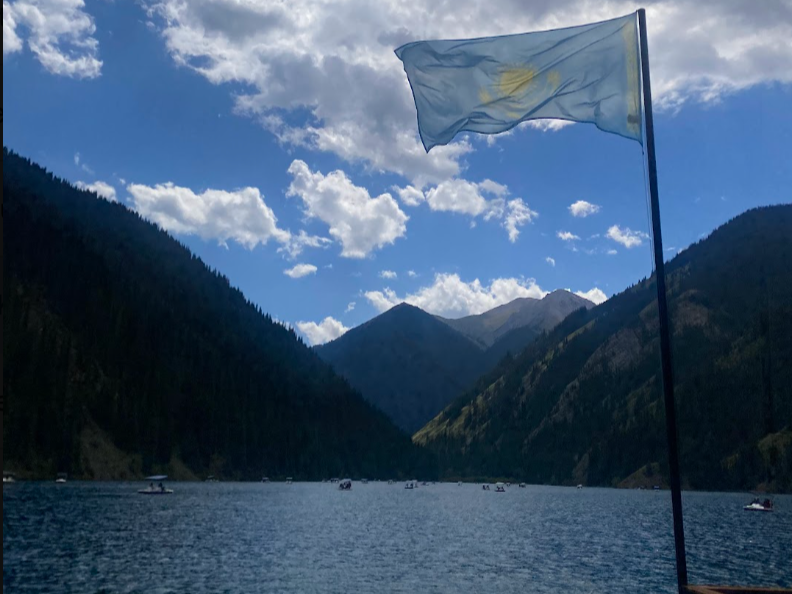
Photo by Sachiko Arai ’29
The flag of Kazakhstan flies high over Kolsai lake, with green mountains visible in the background.
By Sachiko Arai ’29
Managing Editor of Web
This summer, I decided to travel to Almaty, Kazakhstan to visit my friend from college. Once I got there, I immediately noticed how relics of the Soviet era still haunted the city. In the corner of a vintage shop I visited, Soviet rubles bearing Vladimir Lenin’s face were being sold for approximately $1. The train station where I got off was painted entirely in red and was titled the “Moscow Station.” Most of the residential buildings were Khrushchevkas, gray concrete apartment buildings mass-produced during the Soviet era.
Yet, the most enduring relic of the Soviet Union was not something I could see at all. It was something I could hear: The Russian language itself, passing back and forth between people in their everyday lives.
Kazakhstan has long held inseparable ties with its neighboring country, Russia, as well as with its language. Especially during the Soviet era, Russian became widely spoken among citizens alongside Kazakh. Even today, according to BBC News Russian substack, many people in Kazakhstan continue to learn Russian even above Kazakh, because it is more commonly used in educational and professional settings and therefore a tool for career and social advancement.
I was able to observe this linguistic culture on my second day in Kazakhstan. Together with a friend who was a local Kazakh, I joined a tour group and camped at the Assy Plateau, a mountain valley located far from the city of Almaty. The tour was conducted entirely in Russian, so I constantly relied on my friend to understand what was happening. When we encountered nomadic people living near the campsite, I noticed a subtle shift in the sound of the conversations around me.
“We’re switching to Kazakh because the nomadic people can’t really speak Russian,” my friend, who was standing beside me, explained.
During that night, underneath the stars, the tour guide strummed chords on his guitar while the tour group sang in unison, sometimes in Russian, sometimes in Kazakh. As a person who couldn’t speak either, I couldn’t necessarily distinguish the language of the songs. So I simply sat in my seat and closed my eyes, letting my mind roam wide free and across the mountainous lands that surrounded me.
From this unforgettable experience, I was able to realize the unique role and influence Russian has in Kazakhstan. On one hand, it continues to be a crucial language that most people in the country use to connect and communicate with one another. At the same time, it could potentially separate and marginalize certain people, depending on the social group or region they come from, and continues to cement Russian influence over the country.
However, beneath the watchful gaze of Russia, the linguistic landscape of Kazakhstan is now slowly changing. As Kazakhstan seeks greater independence from Russian influence, there have been movements to strengthen Kazakh as the country’s dominant language. In fact, Kazakhstan’s new constitution specifies that Russian “exists ‘alongside’ Kazakh rather than ‘on par’ with it,” signaling a change in the status of Russian. This movement has gained additional momentum amid Russia’s ongoing war in Ukraine. Nationalism has risen among some Kazakhs, accompanied by efforts to strengthen the presence of their own language.
I remember one particular encounter with a Kazakh woman while hiking through the mountains. Although she was Kazakh, she was also fluent in Russian and had even lived in Russia for several years during her childhood. Still, she had become critical of the language and the culture associated with it. She told me, “If I had children, I don’t think I would want to teach them Russian. I don’t agree with what the country is currently doing. And I presume that as the years pass, a divide among the young and elderly will occur because of language separation.”
Of course, it remains unclear whether Kazakhstan's attempt for greater independence could truly carry. For one, the issue carries geopolitical risks. The Jamestown Foundation, for example, argues that Russian commentators see this attempt as hostile and “moving along the same path as Ukraine [that] may require a similar and equally harsh Russian response to maintain Russian President Vladimir Putin’s ‘Russian world.’” Others also argue that Russia’s linguistic influence over Kazakhstan may eventually be replaced not by Kazakh alone, but increasingly by English.
Regardless of what the linguistic politics in Kazakhstan will eventually lead up to, they shed light upon a crucial lesson. In an age where borders between communities are becoming increasingly complicated and disputed, it is not enough to understand communities through the thin lines drawn on a map. Borders are also equally shaped through cultural narratives — language, history, religion and so forth — that overlap or conflict with each other. In other words, understanding the present chaos undertaking our world is a similar attempt to solving a complex puzzle: Every piece is essential in order to understand the whole picture.
Sofia Ramon ’27 contributed fact-checking.
