
politics

Understanding borders: Kazakhstan and the language of independence

Photo by Sachiko Arai ’29

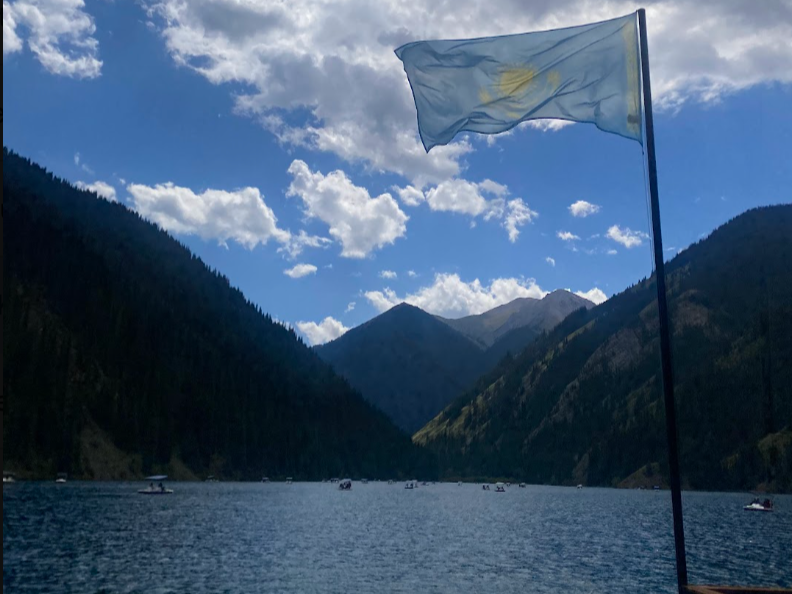
The flag of Kazakhstan flies high over Kolsai lake, with green mountains visible in the background.

By Sachiko Arai ’29

Managing Editor of Web

This summer, I decided to travel to Almaty, Kazakhstan to visit my friend from college. Once I got there, I immediately noticed how relics of the Soviet era still haunted the city. In the corner of a vintage shop I visited, Soviet rubles bearing Vladimir Lenin’s face were being sold for approximately $1. The train station where I got off was painted entirely in red and was titled the “Moscow Station.” Most of the residential buildings were Khrushchevkas, gray concrete apartment buildings mass-produced during the Soviet era. 

Yet, the most enduring relic of the Soviet Union was not something I could see at all. It was something I could hear: The Russian language itself, passing back and forth between people in their everyday lives.

Kazakhstan has long held inseparable ties with its neighboring country, Russia, as well as with its language. Especially during the Soviet era, Russian became widely spoken among citizens alongside Kazakh. Even today, according to BBC News Russian substack, many people in Kazakhstan continue to learn Russian even above Kazakh, because it is more commonly used in educational and professional settings and therefore a  tool for career and social advancement.

I was able to observe this linguistic culture on my second day in Kazakhstan. Together with a friend who was a local Kazakh, I joined a tour group and camped at the Assy Plateau, a mountain valley located far from the city of Almaty. The tour was conducted entirely in Russian, so I constantly relied on my friend to understand what was happening. When we encountered nomadic people living near the campsite, I noticed a subtle shift in the sound of the conversations around me.

“We’re switching to Kazakh because the nomadic people can’t really speak Russian,” my friend, who was standing beside me, explained.

During that night, underneath the stars, the tour guide strummed chords on his guitar while the tour group sang in unison, sometimes in Russian, sometimes in Kazakh. As a person who couldn’t speak either, I couldn’t necessarily distinguish the language of the songs. So I simply sat in my seat and closed my eyes, letting my mind roam wide free and across the mountainous  lands that surrounded me. 

From this unforgettable experience, I was able to realize the unique role and influence Russian has in Kazakhstan. On one hand, it continues to be a crucial language that most people in the country use to connect and communicate with one another. At the same time, it could potentially separate and marginalize certain people, depending on the social group or region they come from, and continues to cement Russian influence over the country. 

However, beneath the watchful gaze of Russia, the linguistic landscape of Kazakhstan is now slowly changing. As Kazakhstan seeks greater independence from Russian influence, there have been movements to strengthen Kazakh as the country’s dominant language. In fact, Kazakhstan’s new constitution specifies that Russian “exists ‘alongside’ Kazakh rather than ‘on par’ with it,” signaling a change in the status of Russian. This movement has gained additional momentum amid Russia’s ongoing war in Ukraine. Nationalism has risen among some Kazakhs, accompanied by efforts to strengthen the presence of their own language.

I remember one particular encounter with a Kazakh woman while hiking through the mountains. Although she was Kazakh, she was also fluent in Russian and had even lived in Russia for several years during her childhood. Still, she had become critical of the language and the culture associated with it. She told me, “If I had children, I don’t think I would want to teach them Russian. I don’t agree with what the country is currently doing. And I presume that as the years pass, a divide among the young and elderly will occur because of language separation.”

Of course, it remains unclear whether Kazakhstan's attempt for greater independence could truly carry. For one, the issue carries geopolitical risks. The Jamestown Foundation, for example, argues that Russian commentators see this attempt as hostile and “moving along the same path as Ukraine [that]  may require a similar and equally harsh Russian response to maintain Russian President Vladimir Putin’s ‘Russian world.’” Others also argue that Russia’s linguistic influence over Kazakhstan may eventually be replaced not by Kazakh alone, but increasingly by English.

Regardless of what the linguistic politics in Kazakhstan will eventually lead up to, they shed light upon a crucial lesson. In an age where borders between communities are becoming increasingly complicated and disputed, it is not enough to understand communities through the thin lines drawn on a map. Borders are also equally shaped through cultural narratives — language, history, religion and so forth — that overlap or conflict with each other. In other words, understanding the present chaos undertaking our world is a similar attempt to solving a complex puzzle: Every piece is essential in order to understand the whole picture. 

Sofia Ramon ’27 contributed fact-checking.

Jimmy Kimmel's suspension is a threat to free speech

Graphic by Mari Al Tayb ’26

By Angelina Godinez ’28

Opinion Section Editor 

Sept. 17 marked the suspension of Emmy-winning late night show, Jimmy Kimmel Live!, after the host, Jimmy Kimmel, made comments regarding the shooter of Charlie Kirk and his affiliation to the far right. Shortly after MAGA media personality Charlie Kirk was shot and killed, outbursts from both the left and right sparked debate on not only the Second Amendment, but also the first: The right to free speech, regardless of your political viewpoints. After weighing in on the debate, and calling out Kirk’s shooter for his affiliation with MAGA, Jimmy Kimmel was temporarily suspended from ABC, a television network that is widely controlled by President Donald Trump's censorship. 

This suspension is quite ironic, considering Kimmel’s comments on Kirk's death are also a form of free speech, something Kirk has been celebrated for posthumously; yet, Kimmel was not glorified nor promised a Presidential Medal of Freedom by the president as Kirk was. The fearmongering influence Trump holds over big news and broadcasting companies should be no surprise, as censorship and bribes have been seen within The New York Times, ABC, PBS, and even The Washington Post, which is owned by right-winger Jeff Bezos. 

Kirk was a close confidant of Trump and a great supporter of his agenda. He was very passionate about traditional, all-American ways of living, such as the right to own firearms. Prior to becoming a victim of gun violence, Kirk once stated, “I think it’s worth it to have a cost of, unfortunately, some gun deaths every single year so that we can have the second amendment to protect our other God-given rights. That is a prudent deal. It is rational.” This rationale seems to only be true, however, when the violence is not being perpetuated against the far right, but against marginalized groups such as transgender youth and people of color.

Minutes before losing his life, Kirk was being questioned about gun violence. He continued to voice biases against supposed gang members and trans youth, painting them as the stereotyped perpetrators of gun violence. Despite these beliefs, Kirk was ultimately killed by a white and cisgender man. This discovery led left- and right-wing politicians alike to debate the glorification of a man who once preached that gun violence — which is most commonly perpetrated against minorities and children — is in fact necessary in order to maintain the right to bear arms. 

Most American late-night television shows use lighthearted rhetoric to discuss politics, so it is in no way shocking for Kimmel to speak on recent events in this way himself. He said, “We hit some new lows over the weekend with the MAGA gang desperately trying to characterize this kid who murdered Charlie Kirk as anything other than one of them, and doing everything they can to score political points from it." This comment is nothing more than a mere observation, especially when compared to the radical and violent threats that MAGA participants commonly make. Regardless, Kimmel was temporarily suspended for his comments criticizing the United States government. It is clear that the current administration would not only rather protect access to firearms over protecting its own supporters, but also has no hesitation in using dystopian censorship to silence anyone who even attempts to rebut their statements. 

It is alarming to see the amount of coverage given the shooting of one cisgender white wealthy man by another, as opposed to the paltry amount given to the Colorado school shooting that occurred the same day as Kirk’s. Or to the teachers, students and international advocates who continue to face daily threats for advocating against what the United Nations Human Rights Council has recently deemed a genocide in Gaza. Prior to this declaration from the U.N.H.R.C., even mentioning genocide and Palestine in the same sentence came with extreme risk, a hypocrisy that is a perfect example of the dictatorial administration we are forced to live in silence under. 

Although it is unfortunate that Kimmel was suspended after such minor comments about the right wing, the same is happening every day on a much smaller, but nevertheless important scale; something that is failing to be covered by news outlets out of their own fear of censorship and lawsuits from the Trump administration. 

It is no doubt that, regardless of Kimmel’s suspension status, he still holds great status and voice within American news outlets. Now, how he and other white men respond to censorship still remains a question. In a day and age where even wealthy white men are at risk of censorship, who will be the first to cross the line and speak up for the years of silencing and threats that marginalized groups have faced? 

Quill Nishi-Leonard ’27 contributed fact checking. 

Kamala Harris spent the debate catering to centrists. Here’s why.

Kamala Harris spent the debate catering to centrists. Here’s why.

Following the Sept. 10 presidential debate broadcast on ABC News, many left-leaning voters were outraged at the strongly moderate or even rightward stances Vice President Kamala Harris took on many key issues. Harris debuted as a Democratic candidate who touts her gun ownership, advances plans to cut taxes and hopes to deregulate government involvement in people’s personal lives. As New York Times columnist Ross Douthat put it, Harris’ current administration is “springtime for neoliberalism,” a political approach that favors free markets and smaller governments; stances that are generally Republican pillars, not Democratic. 

Why aren’t there more women in politics? It’s not about lack of ambition

It is widely recognized and accepted that there is a severe deficit of female political leadership in the United States. Despite comprising over half of the American population, the most recent figures put women’s representation in state and local governments at roughly 25 percent, on average.